Help to Save Eligibility Expands From 6th April 2028: Who May Qualify?
Help to Save eligibility is planned to expand from 6th April 2028, bringing more Universal Credit households within reach of the scheme. The expansion is intended to cover claimants whose Universal Credit award includes the child element, the carer element, or both. HMRC has estimated that around 1.5 million additional households could potentially benefit. The exact practical arrangements should be checked against updated official guidance before applying under the new rules.
THE CHANGE AT A GLANCE
WHAT’S CHANGING
More Universal Credit households are intended to become eligible for Help to Save.
PLANNED DATE
6th April 2028 for the eligibility expansion.
WHO MAY BENEFIT
Universal Credit claimants receiving the child element, carer element, or both.
ESTIMATED REACH
1.5 million
Additional households estimated by HMRC. This is an estimate, not a guarantee of individual eligibility.
What to do: Check the current eligibility rules now if you may qualify already. If you expect to qualify only under the expansion, check GOV.UK again closer to 2028. Article checked: 14th October 2026.
What is changing with Help to Save?
Help to Save is a government-backed savings scheme for eligible people on low incomes. The government has confirmed that the scheme will become permanent and has announced further reforms. The eligibility expansion planned for 2028 is intended to include Universal Credit claimants whose award contains the child element, the carer element, or both. This does not mean every Universal Credit claimant will automatically qualify.
HMRC’s estimate of around 1.5 million additional households indicates the potential reach of the expansion. It should not be interpreted as a promise that every household counted will meet the final eligibility conditions. Applications made before the new eligibility rules take effect are assessed under the current rules.
Who can qualify under the current rules?
According to the current GOV.UK eligibility guidance, you can open a Help to Save account if you receive Universal Credit and you, or you and your partner on a joint claim, had take-home pay of at least £1 in your last monthly assessment period. Take-home pay means pay after deductions such as tax and National Insurance. You must also meet the UK residence or connection conditions. If you live overseas, exceptions apply to certain Crown servants and members of the British armed forces and their partners.
The previous requirement for Universal Credit claimants to earn the equivalent of 16 hours a week at the National Living Wage was removed from April 2025. The current GOV.UK eligibility page focuses on Universal Credit claimants with at least £1 take-home pay in their latest monthly assessment period and does not list Working Tax Credit as a separate route. For that reason, do not rely on older descriptions of tax-credit eligibility. Check the live official rules for your circumstances.
If you and your partner receive Universal Credit as a couple, each of you can apply for your own account if you meet the conditions. You cannot open another Help to Save account if you have already had one.
Check the official Help to Save eligibility guidance on GOV.UK before applying.
Who could qualify under the expanded rules?
From 6th April 2028, the government plans to expand eligibility to Universal Credit claimants receiving the child element, the carer element, or both. The change is intended to make the scheme accessible to some households who do not meet today’s earnings condition, including qualifying people with caring responsibilities who are not in paid work.
The relevant condition is expected to depend on the element included in the Universal Credit award, not simply on whether someone has children or provides unpaid care. Do not assume that either circumstance alone will automatically qualify you. The detailed application process and any other conditions should be checked against updated GOV.UK guidance closer to the start date.
This is a planned future change, not a route to apply under today’s rules. If you meet the current eligibility conditions, you do not need to wait until 2028 to apply.
What else is changing with Help to Save?
The eligibility expansion is part of a wider reform package. The government has announced that Help to Save will become a permanent scheme, that the future scheme will use a multi-provider model, and that bonuses are intended to be paid more frequently, every six months. These changes must be distinguished from the current arrangements described in today’s GOV.UK account guidance.
CURRENT ARRANGEMENTS
What applies now
- Eligibility is assessed under the current rules.
- The current account lasts four years.
- Current GOV.UK guidance describes a first bonus after two years and a final bonus after four years.
- The maximum total bonus is £1,200 over four years.
ANNOUNCED REFORMS
What is intended to change
- Eligibility is due to expand to claimants receiving the child element, carer element, or both, from 6th April 2028.
- The scheme is intended to become permanent.
- A multi-provider model is planned, allowing approved banks, building societies and credit unions to offer accounts.
- The reform design includes more frequent six-monthly bonus payments, intended to be paid directly into accounts.
What still needs to be confirmed?
The government confirmed the multi-provider direction and six-monthly bonus design in its June 2026 reform delivery response. That document says registration for the reformed scheme was being targeted for 2028, subject to final design and implementation planning. It does not mean that the new provider model is already available.
Before applying under the reformed scheme, check the final rules for registration, provider availability, account servicing and bonus calculation. Do not assume the existing two-year/four-year bonus calculation and payment schedule will apply unchanged to the reformed arrangements.
How the Help to Save bonus works under the current rules
THE SAVINGS INCENTIVE
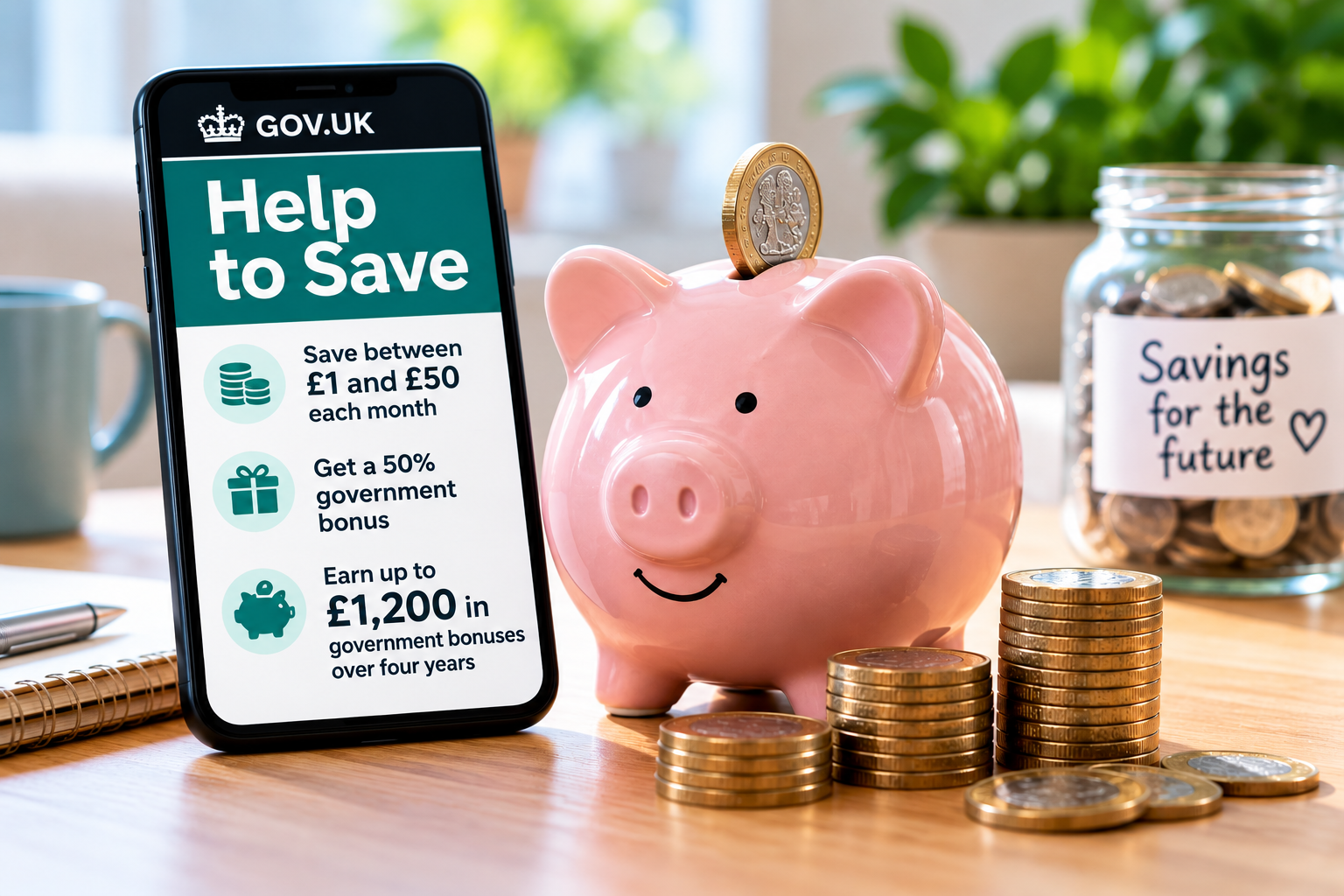
Up to £1,200 in government bonuses over four years
This is the maximum bonus, not the total amount you save. You can deposit up to £2,400 over four years, and the bonus you receive depends on your balances and the scheme rules.
MONTHLY DEPOSITS
Up to £50
in each calendar month
BONUS RATE
50%
calculated using scheme rules
MAXIMUM DEPOSITS
£2,400
over four years
Important: current GOV.UK guidance describes bonuses after years two and four. The reform design is intended to move to six-monthly bonus payments, so check future guidance for the arrangements that will apply to accounts opened under the reformed scheme.
How the current bonus calculation works
Under the current scheme, the first bonus is 50% of the highest balance you reached during the first two years. The final bonus after four years is 50% of the increase in your highest balance during years three and four compared with your highest balance in the first two years. If your highest balance does not increase, you will not earn a final bonus. Bonuses are paid into your nominated bank account, not into the Help to Save account itself.
You can pay in up to £50 per calendar month, but you do not have to deposit money every month. Under the current terms, withdrawing money may make it harder to increase your highest balance and earn the maximum bonus. Closing the account early means you miss the next bonus and cannot open another Help to Save account.
Read the official GOV.UK explanation of Help to Save bonuses. The bonus calculation and payment arrangements for the reformed scheme should be checked against updated official guidance when available.
A worked example under the current bonus rules
ILLUSTRATIVE EXAMPLE: SAVING £25 A MONTH
Deposits over two years
£600
First bonus
£300
Further bonus if the highest balance rises from £600 to £800
£100
Under the current rules, depositing £25 each month for two years without withdrawals gives a highest balance of £600 and a £300 first bonus. If the highest balance later increases to £800 during years three and four, the £200 increase produces a £100 final bonus. This illustrates the current calculation only; it should not be assumed to describe how future accounts under the reformed scheme will be calculated.
Should you apply now or wait?
You may qualify under today’s rules
Check the current criteria and apply now if you meet them. Your four-year account term begins when the account opens, so there is no need to wait for 2028 if you already qualify.
You may qualify only under the future expansion
If your Universal Credit award includes the child element or carer element but you do not meet today’s conditions, follow HMRC updates as April 2028 approaches. Do not apply using rules that are not yet in force.
When will the new eligibility rules take effect?
The Budget 2025 overview of tax legislation specifies 6th April 2028 for the eligibility expansion. Separately, the June 2026 reform delivery response says registration for the reformed scheme is targeted for 2028, subject to final design and implementation planning. The detailed arrangements may be updated before launch.
As of 14th October 2026, the government has announced the reforms, but readers should check updated GOV.UK guidance before applying under the expanded rules or assuming the new provider model is available.
How to check eligibility and apply
If you might already qualify, use the official eligibility guidance and application instructions. You will need to sign in and provide identifying information and UK bank details. HMRC checks eligibility under the current scheme.
Check Help to Save eligibility or read how to apply.
For the scheme’s rules on deposits, bonuses and withdrawals, use the official Help to Save guide.
What remains to be confirmed?
The government has announced the eligibility expansion, the permanent status of the scheme, the multi-provider delivery model and a move to more frequent six-monthly bonus payments. The final practical arrangements for the reformed scheme, including registration, provider implementation and how the revised bonus rules will work in practice, remain subject to final design and implementation planning.
For people expecting to qualify because of the child or carer element, check future guidance on how eligibility will be verified. Do not assume that simply having children or caring responsibilities is sufficient without the relevant condition being met.
Frequently asked questions
Will all Universal Credit claimants qualify from April 2028?
No. The planned expansion is for Universal Credit claimants whose award includes the child element, carer element, or both. Other conditions and the final application rules will still matter.
Is 6th April 2028 confirmed?
The Budget 2025 overview specifies 6th April 2028 for the eligibility expansion. Registration for the wider reformed scheme is targeted for 2028, subject to final design and implementation planning. Check GOV.UK for later changes before applying.
How much can I save into Help to Save?
Under the current scheme, you can deposit up to £50 in each calendar month. You do not have to pay in every month. The maximum over four years is £2,400 in deposits.
Can I get £1,200 in bonuses?
£1,200 is the maximum bonus under the scheme design, not the amount you deposit. Whether you receive the maximum depends on your balances and the applicable bonus rules. Check the official guidance for the rules in force when your account is opened.
Can I apply now if I only qualify under the 2028 expansion?
No. You must meet the rules in force when you apply. If you do not currently qualify, check again closer to the planned expansion.
Will Help to Save affect Universal Credit?
GOV.UK says that if you or your partner have £6,000 or less in personal savings, this will not affect how much Universal Credit you receive, and this includes money in a Help to Save account. Help to Save bonuses do not affect Universal Credit payments. Other benefits may have different rules, so read the official guidance on how Help to Save affects benefits and check your own circumstances.
Can I withdraw my money?
Under the current account rules, you can withdraw money to your bank account. Withdrawals may make it harder to increase the highest balance and earn the maximum bonus. Closing the account early means you miss the next bonus and cannot open another Help to Save account. Check updated rules for the reformed scheme when they are published.
What this means for households
The planned eligibility expansion is intended to bring Help to Save within reach of more Universal Credit households, particularly qualifying families and people with caring responsibilities who may not meet the current earnings condition. The government has also announced broader changes to delivery and bonus frequency.
If you already qualify under the current rules, check whether you can apply now. If you expect to qualify only under the expansion, follow official updates and confirm the final eligibility and account arrangements before applying.
Official sources
- HM Treasury, Budget 2025 overview of tax legislation and rates
- HMRC, Help to Save update, 21st September 2026
- HM Treasury, Help to Save reform delivery consultation response, 23rd June 2026
- GOV.UK, Help to Save eligibility
- GOV.UK, Help to Save bonus rules
- GOV.UK, Help to Save and benefits
- GOV.UK, Help to Save: how it works