
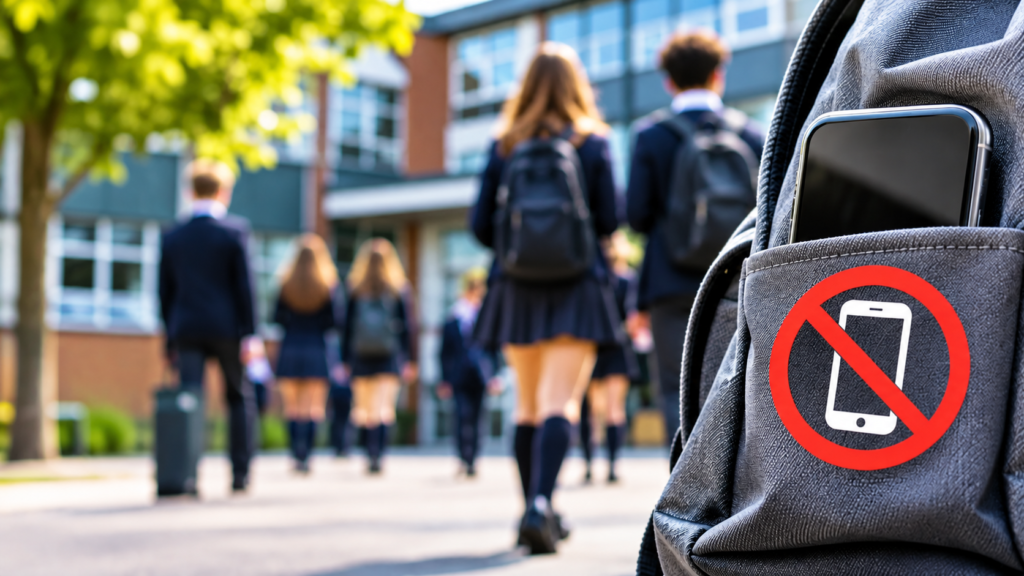
Schools in England already have to follow statutory guidance that says pupils should not have access to mobile phones during the school day. From September 2027, the Department for Education plans to strengthen that guidance and encourage schools to go further than keeping phones switched off in bags or pockets. This guide explains what is changing, what is not yet settled and what parents need to know.
How school phone guidance is changing
From 1st September 2026
Phone-free by default
Phones should be inaccessible throughout the school day. Schools decide how to put the policy into practice.
Strengthened guidance
Stronger arrangements encouraged
From September 2027, revised guidance will encourage schools to keep phones inaccessible throughout the school day, not simply out of sight.
The current statutory guidance took effect on 29th June 2026, and schools were expected to follow it from 1st September 2026. It says schools should be phone-free by default throughout the school day, including lessons, between lessons, breaktimes and lunchtime. Schools must have regard to the guidance, but headteachers decide how to put their policy into practice.
On 9th November 2026, the Department for Education announced that revised guidance will be implemented from September 2027. The Department says the new guidance will encourage schools to move beyond a ‘not seen, not heard’ approach, where phones can remain in pupils’ bags. It will encourage whole-school approaches that keep phones out of use and inaccessible throughout the school day. The guidance will not prescribe one system for every school or make it illegal for pupils to bring phones onto school premises. Schools must have regard to the guidance, but can decide how to meet its expectations.
Which devices could be covered?
Mobile phones
The main focus of the policy.
Smartwatches
May be covered if they can send messages or notifications.
The existing guidance also covers other smart technology with similar communication or recording functions, where the school includes it in its policy. This can include devices that send or receive messages or notifications, or record audio or video. Ordinary school tablets and laptops used for learning are dealt with under separate school device policies.
How will schools keep phones out of reach?
Schools already use different ways to keep phones inaccessible. Examples include:
- 🔒 Lockable pouches
Pupils put their phones in a pouch that stays locked until the end of the day. - 📥 Handing phones in
Pupils give their phones to staff when they arrive and collect them at home time. - 🗄️ Secure storage
Phones are kept in a locked cabinet or another secure place. - 🚫 No phones on site
A school could decide that pupils cannot bring phones onto the premises.
These are examples of approaches already used by some schools. The revised guidance will encourage schools to move beyond phones being left in bags, but it will not make one particular storage method compulsory.
Pouches and secure storage may cost schools money. No specific funding arrangement was confirmed in the announcement.
Will pupils still be allowed to take their phones to school?
The announcement does not introduce a blanket ban on bringing phones onto school premises. Schools will continue to set their own policies, including arrangements for pupils who need a phone for their journey to and from school.
Schools should explain their arrangements to families, including whether pupils can bring phones for the journey, where devices will be stored and what happens if the policy is not followed.
Will there be exceptions for medical needs or disability?
Medical and disability-related exceptions
Schools must still meet their legal duties towards disabled pupils and children with medical conditions. In some cases, this means allowing phone access for a specific health or communication need.
For example, a pupil with diabetes may use a phone linked to a continuous glucose monitor to check their blood sugar levels. A disabled pupil may also need a phone for communication or another disability-related reason. If a phone is needed because of a pupil’s disability, refusing access could breach the school’s duty to make reasonable adjustments.
Other individual circumstances may also need to be considered, including safeguarding or a young person’s caring responsibilities. Any arrangements should be based on the pupil’s needs and agreed with the school. The revised guidance has not yet set out its full approach to exceptions, so families should check the school’s policy rather than assume that every circumstance will be treated in the same way.
What happens if a pupil needs to contact their parent during the day?
Parents should normally contact the school office. Staff can pass on a message or arrange contact with a pupil where needed. The existing guidance also says schools should explain their phone policy clearly to families and be responsive to communication from home.
If you have concerns about safety, travel or a particular family circumstance, raise them with the school. The guidance says schools should consider the risks for children travelling to and from school and work with parents on practical arrangements.
What about school trips and travel to and from school?
Schools can decide how phones are managed on residential trips and activities outside the normal school day. They should consider whether phone use could disrupt the educational experience and whether restrictions are needed.
For the journey to and from school, the existing guidance says schools should consider whether not having a phone could create a risk or a concern for a child. It encourages schools to discuss these issues with parents and consider practical ways to address them.
What happens if a pupil breaks the phone rules?
Each school should explain its phone rules and any consequences in its behaviour policy. The existing guidance says staff should enforce the policy consistently and that misuse of a phone can lead to sanctions. The exact response may differ between schools.
Does the September 2027 change apply across the UK?
This announcement applies to England only. Education is devolved, so each UK nation has its own approach to mobile phones in schools:
Scotland
Updated guidance was published on 30th June 2026. It encourages schools to restrict personal phone use. The Scottish Government has also committed to legislation, with its own consultation and timetable.
Wales
Draft guidance proposes restricting phone use during the school day. Final guidance is expected in early 2027. This is separate from the English change.
Northern Ireland
Guidance published in August 2026 expects schools to be mobile phone-free during the school day. A consultation on possible legislation is open until 19th November 2026.
The four nations are not introducing one shared UK-wide phone ban. Each has its own approach, timetable and policy decisions. The September 2027 change discussed here applies to England.
What should parents do before September 2027?
You do not need to buy a phone pouch or change your child’s arrangements now. The revised guidance is due in September 2027. Your child’s school will explain any changes to its phone policy.
- ✓ Check your school’s current phone policy.
- ✓ Look out for information about storage and collection arrangements.
- ✓ Ask how pupils will contact home during the day.
- ✓ Discuss any medical or disability-related needs in advance.
If your child relies on a phone for a health condition, communication or another specific need, raise this with the school before any new arrangements begin. It is better to agree a suitable plan in advance than wait until the policy changes.
Quick answers
Frequently asked questions
Answers to common questions about the planned school mobile phone rules in England.
When do the new school phone rules start in England?
The revised guidance is due to be implemented from September 2027. Its full wording has not yet been published.
Are mobile phones being banned from schools in England?
The Government wants schools to move away from policies where phones are switched off but left in pupils’ bags. The revised guidance will encourage schools to use stronger approaches, but this will not be a legal requirement.
Will every school use the same system?
No. Schools will be able to choose arrangements that work in their setting. Examples already used include collecting phones at the start of the day and keeping them in secure storage. The announcement does not set one compulsory storage method.
Can a school make an exception for a child with diabetes or a disability?
Yes, where a pupil needs access because of a disability or medical condition, the school must consider its legal duties and the individual circumstances. This may include access for health monitoring or communication.
Could smartwatches be included?
Yes. The existing English guidance can cover smart technology with similar functions, such as sending messages or notifications or recording audio or video, where it is included in the school’s policy.
Does the September 2027 announcement apply to Scotland?
No. The announcement applies to England. Scotland has separate guidance and is developing its own approach.
Do sixth-form students have to follow the same rules?
Yes, schools can consider allowing sixth-form students limited access at certain times and in specific locations, such as a sixth-form common room. The existing guidance says this should not undermine the rules for younger pupils. The updated guidance may clarify whether this flexibility continues.
More changes affecting children and families
UK Plans Social Media Ban for Under-16s From Spring 2027 →
What the proposed restrictions could mean for children, parents and access to social media.
Scotland’s Free Welcome to School Bag for Primary 1 Children Starts in August 2027 →
What families in Scotland can expect from the new school-start support for Primary 1 pupils.
England to Ban Sales of High-Caffeine Energy Drinks to Under-16s From April 2027 →
A separate change affecting under-16s, including which drinks and retailers may be covered.
This article is general information based on the announcements and guidance available when checked. The final English guidance may clarify or change the arrangements described here. Check your child’s school for its policy and the relevant government guidance for the latest position.